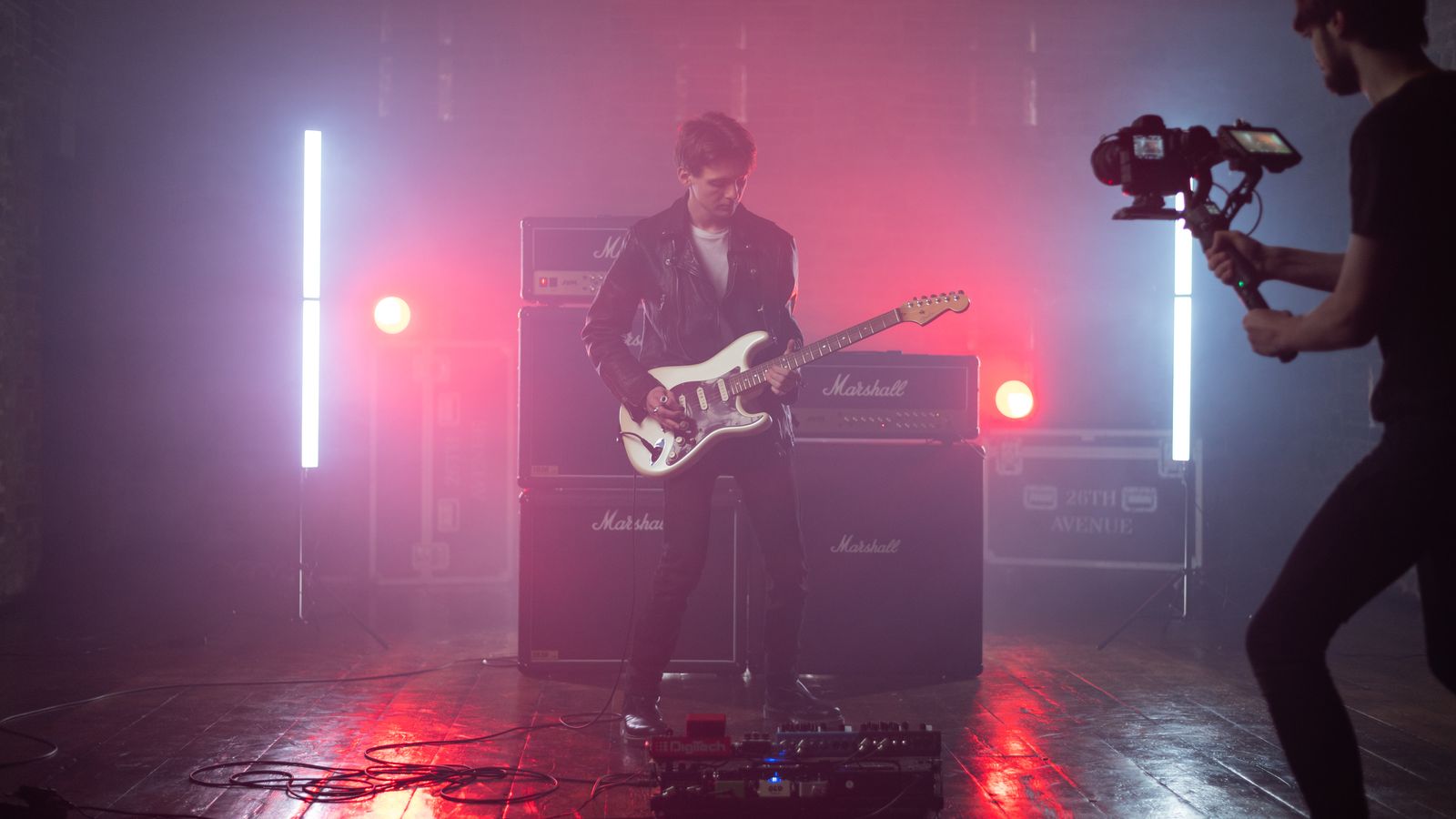
You have a finished master, a release date three weeks out, and a budget that will not cover a two-day shoot with a crew of fifteen. So the question in the room stops being whether an AI studio can make your music video. It becomes a much more useful question: of the eighty to a hundred shots a three-minute track needs, which ones can be generated, which ones have to be filmed, and in what order do you decide.
That decision is where most music video projects go wrong. Artists commission a treatment, fall in love with a mood board, and only discover in the edit that the one thing the song is about — the artist's face on the chorus — is the one thing the pipeline handles worst. The plan below is the order we work in, and it exists to prevent that.
Build the shot map from the track, not from a mood board
Mark the song before anyone opens a generation tool. Import the master, and cut it into its real sections: intro, verse, pre-chorus, chorus, verse two, bridge, final chorus, outro. A three-minute song almost always has six to eight of these, and they are not interchangeable — the bridge needs a different visual temperature than the second verse.
Then mark the hooks. Not "the chorus", but the specific two to four seconds where the title line lands, or where the beat drops out. Those frames get the strongest image in the video and the most generation attempts. Everything else can be coverage.
Finally decide average shot length per section. Verses breathe: three to four seconds per shot. Choruses cut faster: one and a half to two and a half seconds. Do the arithmetic before you promise anything. A three-minute track at a 2.5-second average is roughly 72 shots, and once you add alternate takes, safety frames and transitions, you are planning 90 to 110 units. That number, not the song's length, is what determines your budget and your schedule.
Sort every shot into three classes
Every shot in the map falls into one of three jobs, and the classes behave very differently.
Performance shots — the artist singing or playing to camera — are the hardest. AI handles a medium shot with movement, a three-quarter angle, or a profile far better than a locked-off close-up, because a sustained close-up gives the viewer time to study the mouth. Narrative shots — an actor walking through a location, a hand opening a door, a car pulling away — are where generation earns its money: they are short, they are numerous, and small inconsistencies read as style rather than error. Texture shots — light on a wall, smoke, fabric, rain on glass, a lens flare — are cheap, forgiving, and buy you ten to fifteen seconds of breathing room that would otherwise cost a location fee.
The working rule: film the performance close-ups, generate the narrative and the texture, and treat performance mediums as a case-by-case decision based on how much the artist's mouth is visible.
Consistency across seventy shots is the real production problem
A music video is not one image, it is a chain of them, and the audience notices when the chain breaks. Two shots of the same jacket in slightly different greens will pull a viewer out of the song faster than any technical flaw.
Before generating anything, build a character sheet: four to six reference stills of the artist in final wardrobe under final lighting — front, three-quarter, profile, back, plus one full body. These stills are the contract for every subsequent shot, and they should be approved by the artist, not just by the director.
Then lock the details that generation will quietly reinvent: jewellery, nail colour, a logo on a jacket, the side the hair is parted on, whether the shirt is tucked. Write them down. A two-line wardrobe note saves a day of regeneration.
Do the same for locations. Each set gets a lighting bible: key direction, colour temperature, one practical light source that appears in every shot of that section. If the club section has a red neon tube on the left of frame, it has that tube in all fourteen shots, or the section stops feeling like one place.
Test five shots before committing to eighty. If the face drifts in a two-shot, or the wardrobe changes between angles, restructure the scene — more singles, fewer two-shots, tighter framing — rather than fighting the model for a week.
Lip-sync: decide early, not in the edit
Close-up lip-sync is still the weakest link in the chain, and it is the first thing an audience checks. If the emotional centre of the video is the artist's face during the chorus, film that. It is one day with a small crew, and it will carry the whole piece.
Generated performance does work, under conditions. Framing around 30 to 50mm equivalent, with real head movement, hair falling in front of the mouth, a microphone or a hand covering the jaw line, or the artist turned away from camera. Those are not compromises, they are the grammar of the genre — much of the last thirty years of music video hides the mouth deliberately.
Give the artist a version of the track with a click or a rough bed to perform to, and keep the master for the edit. Tempo mismatches that look fine on set become visible drift once the vocal is locked.
For vertical delivery, regenerate the key shots instead of cropping. Cropping a 16:9 close-up to 9:16 routinely cuts the chin off and pushes the eyes out of the upper third.
Edit for the rhythm the tools give you
Generated shots are strongest between one and a half and four seconds. Plan cuts on beats rather than bars, and let the chorus cut faster than the verse — that is the genre's own editing logic, and it also happens to hide the seams between generated units.
Keep a bank of ten to fifteen connective shots: hands, feet, an eye, a light flicker, a match being struck, a curtain moving. They cost very little and they stitch generated sequences into something that reads as continuous.
One discipline that matters: do not let a beautiful shot run six seconds because it took four attempts. Sunk cost is not an editorial reason. If a shot only works when it is long, it usually does not work.
Deliverables, rights, and what to settle in writing
Decide the deliverable list before the first generation, because it changes the shot map. At minimum: a 16:9 master, a 9:16 vertical cut, and a 1:1 or 4:5 version for feed placements. Vertical is not a crop of the master, it is a second edit with its own framing and its own opening three seconds.
Sort the paperwork alongside the creative. Generated shots of a real artist need a written release that explicitly covers AI-generated depiction, the term of use, and the territories. The studio needs written confirmation that the artist or label controls both the master recording and the composition. And ask which generation models were used and whether the plan those models were used under permits commercial output — a studio that cannot answer that question is a liability on a paid release, however good the frames look.
Timeline and money, honestly
Pre-production, meaning the track map, references and tests, runs three to five days and is the part clients most want to skip. Generating and selecting 80 to 100 units takes another four to seven days. Edit, grade and sound design take three to four. One revision round is included in a normal quote; two is realistic for music, and the second round is usually about pacing rather than fixing shots.
A video that would have needed a two-day shoot with a crew and a paid location typically lands in two to three weeks. A hybrid — one filmed performance day plus generated narrative coverage — sits in the middle on cost and often looks the most expensive of the three, because the artist's face is real where it matters and everything around it is unconstrained.
What AI does not remove is the decision about what the song looks like. That still needs a director, a treatment, and two honest conversations with the artist about what the budget can carry.
If you have a master and a release date, send both to KAMOD AI in Tashkent along with two videos you love and one you hate. The one you hate is usually the more useful document, and it is where the shot map starts.