A contractor in Tashkent sent us the film he had lost a tender with. Ninety seconds, drone shots of a completed tower, a synthesised string section, a logo at the end. It was well made. The evaluation committee still asked him one question the film could not answer: how do you keep the second tower crane clear of the school gate at eight in the morning? The winning bid had a three-minute film with a chapter on site logistics. It looked cheaper. It answered the question.
Construction is the vertical where AI video is most often sold badly, because the industry's own imagery is so easy to fake: cranes against blue sky, a hard hat in golden light, time-lapse of a concrete pour. None of that gets a contractor shortlisted, gets a worker home safely, or gets a client to sign. What construction buyers actually judge is sequence, accuracy and logistics. That is a much narrower brief than a mood reel, and it is where a studio earns its fee.
Three films that are not the same film
Almost every construction company we work with needs three distinct pieces of video, and they are routinely confused into one.
The first is the company or project film: who you are, what you build, how you run a site. It sells to developers, buyers and sometimes lenders. It can carry atmosphere and it should be short.
The second is the safety induction. It is watched by every new worker, sub-contractor and visitor, often on a phone in a site cabin, usually in Uzbek and Russian, and it has to match the procedure written in your HSE manual line by line. Accuracy is not a style preference here, it is a legal exposure.
The third is the tender or prequalification film. It goes to an evaluation committee that has four other submissions and forty minutes. It wins on logistics, phasing and risk, not on renderings.
A single film that tries to do all three usually ends up too long for sales, too vague for HSE and too pretty for procurement. Splitting the brief costs less than most contractors expect, because the expensive part of the work, the site access and the real footage, is shared.
Where generated footage breaks on a site
A video model has never poured concrete. It has seen photographs of concrete being poured, which is not the same knowledge. On construction subjects the failures are consistent and specific.
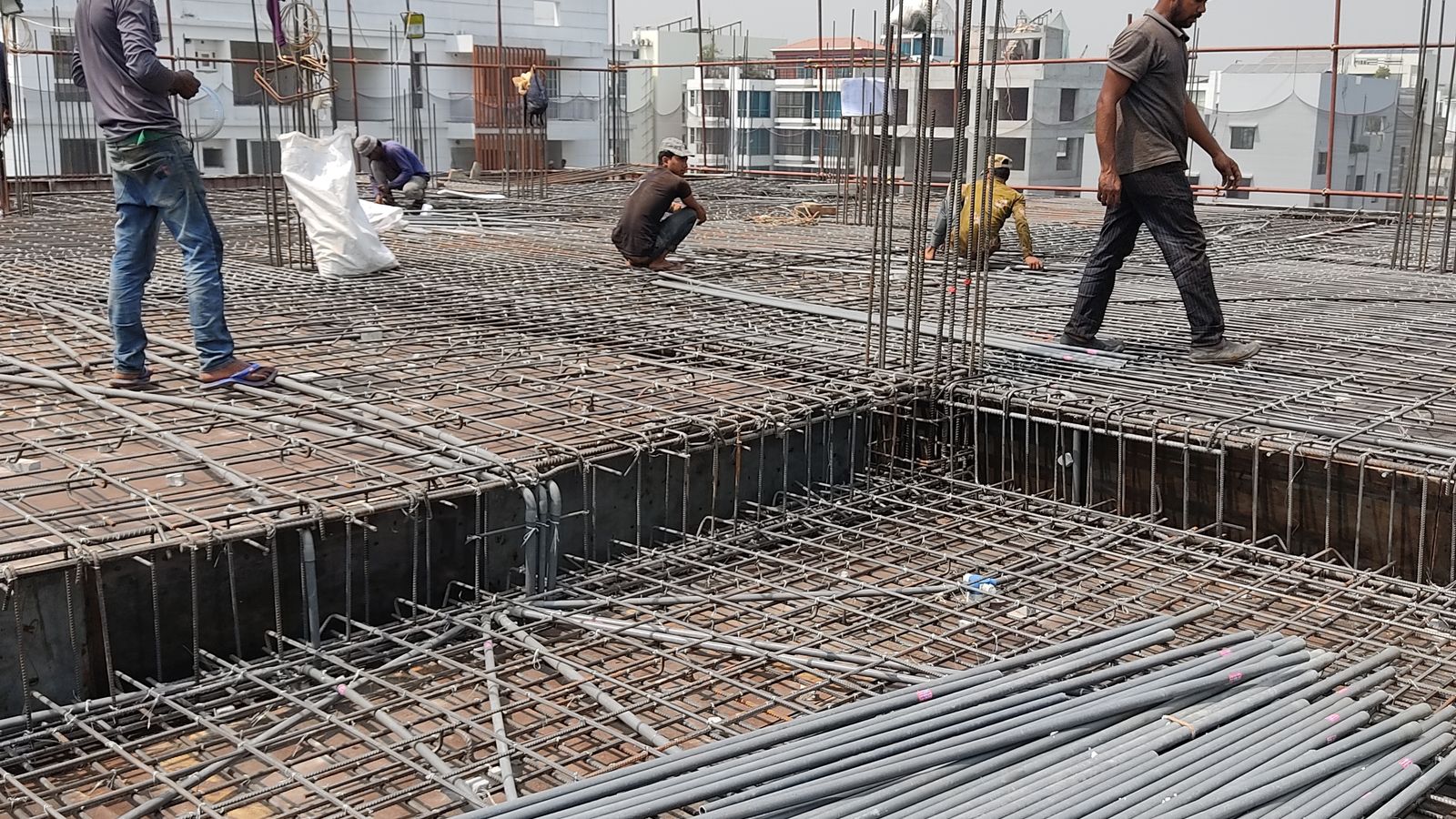
Structure is the first casualty. Generated rebar has no consistent spacing and no laps. Generated scaffolding has ties in the wrong place and standards that do not reach the ground. Generated formwork bulges in ways that would have failed. A structural engineer spots this in about four seconds and, having spotted it, stops believing the rest of the film.
Machinery is the second. Excavators that swing through their own tracks, cranes lifting loads that are visibly heavier than the boom could take, a concrete pump whose boom articulates in an impossible order. Site people watch machines the way other people watch faces.
Safety detail is the third and the most damaging. Generated workers appear without harnesses at height, with hard hats worn backwards, standing inside an exclusion zone, or operating a chop saw without a guard. For a sales film this is embarrassing. For a safety induction it is unusable, because the film is now teaching the wrong thing.
Our rule is blunt: if a frame will be inspected by an engineer, an HSE officer or a crane operator, it is real footage or a proper 3D model, not generation. Generated material is for what the camera cannot reach.
The hybrid that actually survives scrutiny
The workable method is to shoot the truth and generate the rest.
Real plates come first: drone passes over the site at two or three times of day, a gimbal walk through the actual works, close detail of hands, tools, rebar, formwork, the site office, the gate, the hoarding. That footage is cheap to shoot on a half-decent day and it is the part nobody can argue with. Even a phone at 4K on a gimbal is enough for inserts.
Generation is then used where physical production is impossible or wasteful: the building as it will look in eighteen months, lifted out of the ground in a phasing sequence; a camera move through a wall that does not exist yet; dusk or winter light on a structure still under frame; a district context view that would need a helicopter and a permit. In these shots there is usually no worker visible and no machine close enough to be inspected, which is exactly why they pass.
The seam between the two has to be managed in grade and in sound. Real drone footage from a hazy Tashkent afternoon and a clean generated plate do not match until both are graded to the same contrast and both carry the same wind and site ambience. We spend roughly a third of post time on that seam, and it is the difference between a film that reads as one place and a collage.
The safety induction you cannot generate
This is the one deliverable where we refuse generation entirely for anything a worker is meant to copy. Every shot of a person doing a task correctly is filmed with your own crew, in your own PPE, following your own procedure, signed off by your HSE lead before the edit is locked.
Two production decisions make the difference. First, chapter it. Eight to twelve minutes in six or seven chapters, each one covering a single risk, each with a clear title card and a still frame. When a procedure changes, you re-shoot one chapter, not the film. Second, shoot each chapter twice in the same take for language: the same action, the same framing, the voice-over recorded separately in Uzbek and Russian, with on-screen text in both. Workers who read one language and speak another get both.
What generation is good for here is the dangerous demonstration: the collapse, the fall, the struck-by. We do not drop a real load to show what a dropped load does. That reconstruction is generated, it is labelled as a reconstruction on screen, and it is kept to a few seconds. Anything longer and the audience starts watching the effect instead of the rule.
Tender films win on sequence, not spectacle
An evaluation committee is not buying beauty. It is buying confidence that you understand the site, the neighbours, the traffic, the utilities and the calendar.
So the structure is chronological and specific. How the site is secured on day one. Where the hoarding goes and what the school behind it will see. How deliveries enter and leave, at which hours, with which banksman. When the crane is erected and when it comes down. What happens to the existing drainage. What the phasing looks like month by month, drawn over the real aerial plate.
Generated phasing is genuinely useful here, because it can show the build in sequence off a real photograph of the plot. It also has to be honest. Never show a completion date you do not have, never show a finished facade where the schedule says shell and core. Procurement people compare the film against the programme document, and a mismatch is worse than no film.
Three minutes, chapter markers, one speaker at most, and subtitles in the language of the committee. Silence over a good aerial plate is stronger than music over a weak argument.
What it takes, and what we get asked
A ninety-second site film using footage you already have plus two days of drone and gimbal work runs five to seven working days from approved script. Add generated phasing and it is closer to two weeks, because phasing is designed shot by shot against the programme.
A safety induction of eight to twelve minutes in two languages is a three-week job, most of it scheduling crews to be filmed doing the right thing at the right stage of the build.
A tender film is two to three weeks and depends almost entirely on how fast your programme and logistics documents are ready, not on us.
None of this is priced per second of finished video, and any studio that quotes you that way has not made one of these films. It is priced by shoot days, number of chapters and number of generated sequences, because that is where the labour actually sits.
What if we have no drone footage yet? Then that is the first production day, and it is the cheapest day in the whole job. Two hours over the site at the right time of day gives us the base plate that everything else hangs on.
Can you make the building look finished before it is? Yes, and we will mark it clearly in the caption and in any frame where a viewer could mistake it for current progress. Investors accept a rendering when it is labelled. They do not forgive one that is passed off as a site photo.
Do generated workers ever appear in a safety film? No. If a person is demonstrating a procedure, it is a real person on a real site. Generated people appear only in reconstructions of accidents, labelled as reconstructions.
How do you handle our sub-contractors appearing on camera? We film with a one-page release signed on site, in the worker's language, and we keep faces out of frame where a release is not practical. It is a twenty-minute conversation at the start of the shoot and it prevents a problem two years later.
Who signs off the safety induction? Your HSE lead, on the script and again on the locked edit. We do not publish an induction film without written approval from the person who owns the procedure, and we keep that approval on file.
If you are preparing a tender, an induction or a project film this quarter, send the programme document and the site address before you send a brief. Those two files decide most of the budget, and we can tell you within a day which shots are worth filming and which are worth generating. KAMOD is an AI video studio in Tashkent working with contractors and developers worldwide, and we will tell you plainly when the honest answer is a camera, not a model.