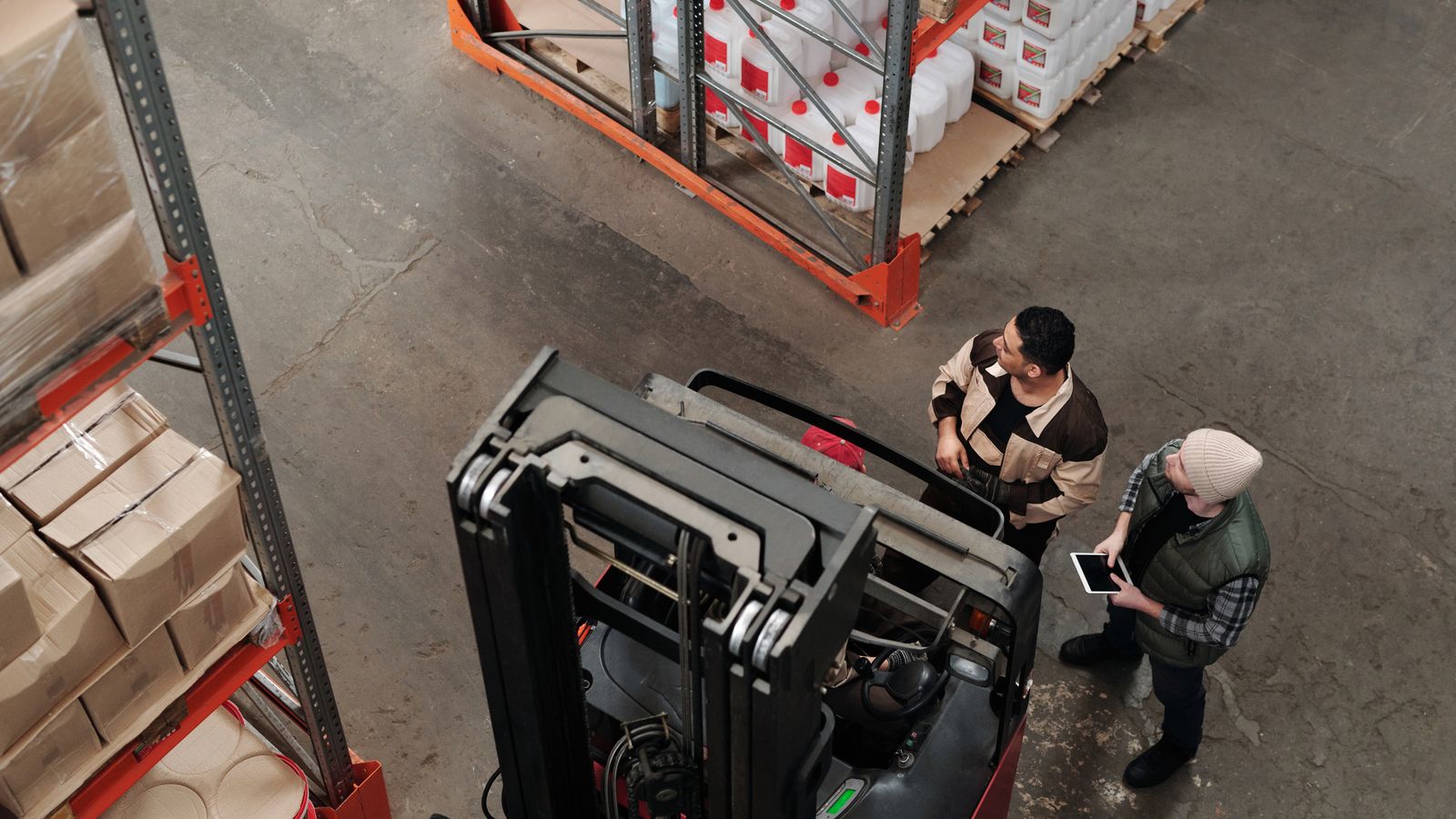
A freight forwarder running Tashkent–Almaty–Moscow lanes still has the website film it commissioned in 2019. It shows a warehouse the company no longer leases and trucks it never owned, and the sales team attaches it to every rate request because there is nothing else. Replacing it means six sites in three countries, drivers who are contractors rather than staff, and a filming window that keeps slipping because somebody always has a load to move. The video is now seven years old and every quarter it stays live costs a little credibility.
That gap is where AI video earns its place in logistics. Not as a replacement for a shoot, but as the way to produce the eighty percent of freight communication that was never going to get a camera crew at all — the lane explainer, the onboarding chapter, the version in Kazakh, the update after the border procedure changed.
The four films a freight company actually needs
Most operators ask for a brand film and need four other things.
A capability film, sixty to ninety seconds, that sits behind a rate request and answers the question a shipper's procurement team is actually asking: which lanes, which cargo types, which equipment classes, what warehouse footprint, which certificates. No music-led montage. A montage tells a procurement officer nothing.
Lane explainers, thirty to forty-five seconds each, one corridor per film: origin, transit points, border crossing, transit time, what happens when a truck is held. These are the cheapest assets to produce and the most requested by sales, because every new shipper asks the same question about the same route.
Driver onboarding and safety induction, three to six minutes, chaptered. This is the highest-volume item in the whole library and the one that is remade most often, because border procedures, permit rules and site layouts change. It also has to exist in Uzbek, Russian and often Kazakh, which is where production budgets usually collapse.
Recruitment film for drivers and warehouse staff, sixty to ninety seconds. It competes with every other employer in the city for the same forty candidates, so it has to state the shift pattern, the pay structure and the time away from home honestly. A film that hides the night shift produces applications that end in the first week.
The inventory logic matters more than any single film: one master asset with a set of derivatives that can be updated independently. The onboarding series is the one that pays for itself, because a single border rule change used to mean re-shooting a section, and now it means regenerating two shots and re-recording one paragraph.
Warehousing you have not built yet
The most useful thing generation does for a logistics company is show a facility that does not exist. A cross-dock layout, a new cold room, a picking line being added in Q2 — all of it can be visualised before the lease is signed, in three revisions, for roughly what a single shoot day costs. That is genuinely new capability, and freight operators use it in front of banks and shippers long before steel goes up.
The trade-off is credibility. Generated footage cannot show your racking, your staff, your forklifts or the actual condition of your floor. And a surprising number of tenders ask for evidence of facility, so a rendered warehouse presented as a real one is not a marketing shortcut, it is a disqualification risk. The workable rule is to label illustrative footage as illustrative, keep site photography alongside it in the same deck, and never let a render stand in for documentation of an existing site.
Lane visuals: what a generated frame can and cannot claim
A driver watching a film about the Tashkent–Almaty run knows exactly where the queue forms, which stretch is under repair in April, and what the checkpoint looks like at two in the morning. Generate a border post that does not resemble the real one and you lose the single audience whose opinion decides whether the film is respected internally.
So the split is by audience, not by convenience. Route animation built on real distance and waypoint data, real dashcam or phone footage wherever it exists, and generated frames only for the generic middle: a truck on an open highway, a terminal at night, a container yard in the rain. Transit times, weights and permit numbers belong in typographic lower thirds, never baked into a rendered scene, so a schedule change means editing a caption rather than rebuilding the shot. That one decision saves more money over a year than any discount on generation.
Language is the operational problem, not the creative one
Driver-facing content in this region usually needs Uzbek, Russian, Kazakh and English, and the naive plan — dub the master four times — is where most budgets go wrong. A talking head needs lip-sync and a voice that matches the speaker's age and register. A voice-over over b-roll needs neither, and costs a fraction of the same runtime. Decide per scene which one you actually need, because a five-minute onboarding film is mostly b-roll and mostly does not need lip-sync at all.
The bigger risk is terminology. Freight language is full of pairs that mean different things: a curtain-sider is not a tent, a permit is not a licence, tare weight is not payload, and the Russian and Uzbek terms drivers actually use often differ from the ones in the translated procedure document. Lock a glossary of forty to sixty terms in the brief, before any generation begins, and have a dispatcher who works the lane read the script. One wrong term in the first ten seconds and the driver stops trusting the rest of the film, however good the picture is.
Voice consistency across four languages is solvable with a consented clone of one real dispatcher, which keeps the same person teaching in every language. The trade-off: a cloned voice reading a technical script still needs a human pass for stress and emphasis, and anything with legal or safety weight should be reviewed by whoever owns the procedure, not by the studio.
Where generation stops: damage, claims, customs, safety
Some freight content must never be generated. Cargo damage for an insurance claim, customs inspection sequences, hazmat and ADR handling, incident reconstruction, anything that could later be read as a record of what happened. Footage that looks like evidence is a legal exposure, and insurers and auditors treat synthetic frames accordingly. Safety induction content is also increasingly audited, so a generated frame of a worker doing a task the wrong way is worse than no frame at all.
The line is simple to state and easy to apply: generated footage is for explaining, real footage is for proving. Anything that might be examined after an incident stays real, shot at the site, with a date.
What it costs, how long it takes, and the brief that survives review
A capability film runs two to three weeks from approved brief, with the first cut inside ten days. Each language variant adds two to three working days and can run in parallel once the master is locked. A chaptered onboarding series is four to six weeks, mostly because scripts need sign-off from operations and safety, not because rendering is slow.
Budget follows four variables: number of distinct scenes, number of languages, number of revision rounds, and how much of the environment is generated rather than supplied. The master is the expensive part; derivatives are marginal once the master exists. Anyone quoting a single number before the scene list and the language list are agreed is quoting a number that will be renegotiated later.
One page is enough if it answers the right questions: who watches this and what decision should change afterwards; the three scenes that carry the argument; the glossary; which real assets you can supply — site photos, dashcam clips, route lists, brand book, existing subtitles; the delivery formats, which for freight usually means 16:9 for the site and tender deck, 9:16 for driver recruitment, and a silent version for trade show screens; the languages; who signs off, by name; and what done looks like.
Add two reference films, one you rate and one you do not, each with a sentence explaining why. That single page removes more revision rounds than any amount of back-and-forth after the first cut.
If you run freight and want to see what a lane explainer or one onboarding chapter would look like with your own route data, send us one lane and one page of glossary. KAMOD is an AI video studio in Tashkent working with logistics operators across Central Asia and beyond, and we will come back with a scene list and a fixed price before anything is generated.