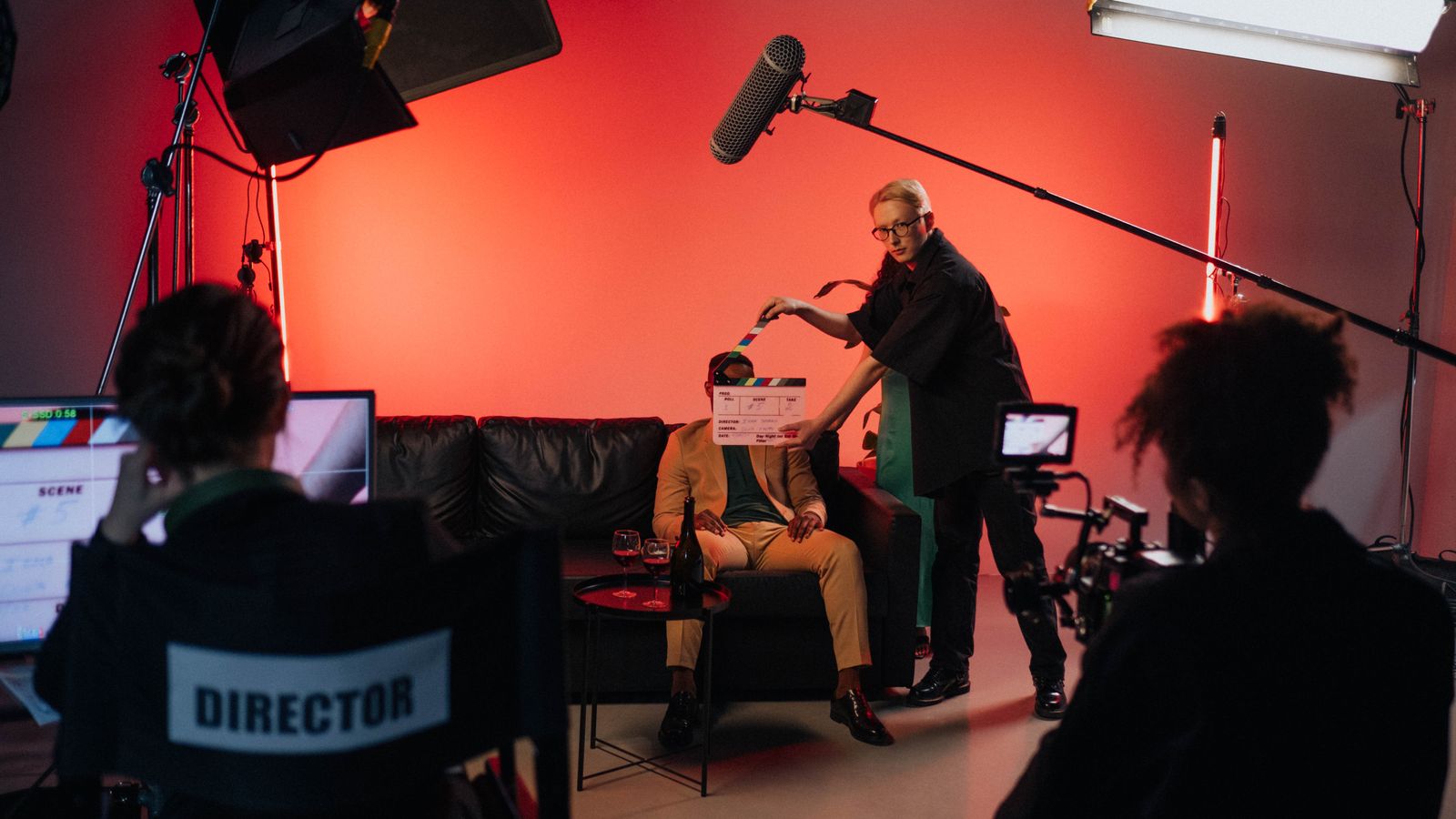
A client approves a 40-second presenter spot. On a phone it looks fine. Then it goes on a 55-inch screen in a meeting room and the room goes quiet: the mouth is moving, the words are right, but the face is half a beat behind the voice. Nobody can say exactly what is wrong, only that it feels dubbed. That gap — usually 60 to 120 milliseconds — is the most common reason an otherwise good AI video gets rejected at the final review.
Lip-sync is not one problem. It is two, and they fail differently.
Driving a face from audio, or matching audio to a face
The first job is generative: you have a voice track and you need a mouth to produce it. A model analyses the waveform, estimates phonemes, and pushes the jaw and lips into roughly the right shapes per frame. The result is convincing at a glance and fragile under scrutiny, because the model is guessing which sounds are being made rather than watching a mouth make them.
The second job is editorial: you have footage of a real person and you need the audio to fit the shapes they actually made. This is closer to traditional dubbing and it has hard limits — you can time-stretch, cut on breath, and rewrite lines, but you cannot invent mouth shapes that were never filmed.
Most projects fail because somebody planned for job one and delivered job two, or the reverse. Decide which one you are buying before the first shot is generated. If the presenter must say specific numbers, names and a legal disclaimer, generative lip-sync is the right tool. If the face is the brand and the words are flexible, re-voicing existing footage is cheaper and looks more honest.
The frame budget: what the eye actually tolerates
Timing is not subjective. At 25 frames per second, one frame is 40 milliseconds. Research on broadcast dubbing and our own review notes converge on the same working thresholds:
- Up to 2 frames (80 ms) of offset is invisible on a locked medium shot.
- 3 to 4 frames reads as "slightly off" to a trained eye and passes to an audience that is not looking for it.
- Beyond 5 frames, viewers stop watching the story and start watching the mouth.
Those numbers move with camera distance. A tight close-up on a talking face has a tolerance of roughly half what a medium shot allows, because the mouth fills more of the frame and the viewer's attention is concentrated exactly there. In a wide shot, lip-sync effectively stops mattering — a two-frame error on a figure eight metres from camera is unreadable. This is why the cheapest fix for a failing close-up is usually to cut to something wider.
Shot design that survives synthesis
If you know a shot will be lip-synced, design for it:
- Keep the head within about 15 degrees of frontal. Profiles and three-quarter turns force the model to invent geometry it cannot see, and the jaw line drifts.
- Avoid hands near the mouth. Occlusion is where the artefacts live — fingers, microphones, a coffee cup all produce a smear at the contact edge.
- Break long paragraphs into 6 to 12 second takes. Error accumulates; a clean 8-second take is worth more than a 30-second one that drifts.
- Lock the camera. A slow push-in is fine. A handheld move while the subject talks makes every timing error look worse than it is.
- Give the actor something to do with their mouth when not speaking — a closed-lip pause, a breath, a look away. Continuous speech for twenty seconds is where synthetic faces look most synthetic.
Script adaptation is where Russian and Uzbek projects break
Speech rate differs by language and it hits lip-sync directly. The same sentence typically runs 12 to 20 percent longer in Russian than in English, and longer still in Uzbek, which is agglutinative and adds suffixes where English uses separate words. If you generate a 30-second English take and then try to fit a literal Russian translation into the same 30 seconds, the voice must either speed up past natural or the mouth must fall behind. Neither is fixable in post.
Two practical rules. First, adapt the script per language rather than translating it: fewer clauses, shorter words, one idea per sentence. Second, budget the timing separately — write the Russian and Uzbek versions first if those are the primary markets, then let the English version breathe into whatever space is left. Round-trip translations of a lip-synced script almost always lose 10 to 15 percent of the nuance, so keep a native reviewer in the loop for each language rather than trusting a machine pass.
Plosives are the other trap. Sounds like b, p and m require the lips to close fully, and closure is the single easiest thing for a viewer to spot when it is missing. Lines dense with them — "brand protection programme", "buy before Monday" — are the ones that look worst. Where possible, rewrite to softer consonants; where not possible, cut away for that half second.
A review protocol that catches what the room catches
Reviewing lip-sync by watching once at normal speed is useless. Use this instead:
1. Scrub at quarter speed through every close-up, watching only the mouth, with sound off, then again with only the audio audible and the picture hidden. The mismatch shows up immediately when the channels are separated. 2. Watch the whole spot at normal speed on a phone at arm's length, then on the largest screen you have. Errors that vanish on a phone are obvious at two metres. 3. Check the first and last frame of every cut. Models tend to settle at the start of a take and drift at the end; the tail of a clip is where the jaw loses the vowel. 4. Listen for sibilance and for consonants that land on the wrong frame — a "s" that arrives one frame late sounds like a lisp. 5. Confirm the subtitle or on-screen text timing matches the new audio, not the old one. A correct mouth with subtitles half a second early reads as broken.
Keep the notes specific: "frame 112, the p in 'project' has no closure" travels further than "the sync feels off". A studio can fix a named frame; it cannot fix a feeling.
What to do when a shot will not sync
Sometimes the honest answer is that this take will never be right. Three fixes, in order of cost:
Cut away. A reaction shot, a product insert, a wide of the room — two seconds of coverage lets the audio continue while the mouth is off screen. This is what broadcast dubbing has done for fifty years and it still works.
Change the delivery. Turn the line into voice-over over b-roll. If the speaker's face is not essential to the sentence, removing it removes the problem entirely.
Regenerate with a tighter brief. Shorter line, frontal angle, no hand occlusion, one clause. About one in five problem shots is fixed by this alone, and it is cheaper than a reshoot in every case.
What no studio can do is promise frame-perfect sync on arbitrary footage at any camera angle. Anyone who does is either not measuring or measuring against a standard you would not accept in a screening room.
Where this leaves your project
If you are planning a presenter-led video for the Uzbek, Russian or wider market, send us the script and the shot list before generation. We will tell you which lines will survive lip-sync, which shots need to be designed differently, and where a cutaway will save you a regeneration cycle. KAMOD is an AI video studio in Tashkent working with clients worldwide — the review happens on real frames, not on a promise.