Product Video for Uzum, Wildberries and Ozon: What Makes a Card Convert
A seller in Tashkent lists forty SKUs across three marketplaces. Every card has eight photographs, a clean white background, the right category, the right price. The video slot is empty on all forty, because the seller tried once, uploaded a five-slide montage with a stock music track, watched nothing happen, and concluded that video does not work on marketplaces.
The conclusion was wrong. The video was wrong.
A slideshow with a slow zoom is not a product video. It spends the buyer's first three seconds moving between stills that they could already see in the gallery, and it returns nothing: no new information, no sense of scale, no proof that the object exists in the physical world. The buyer scrolls, and the seller learns the wrong lesson.
The card is a shelf, not a page
Marketplace shopping does not happen on a page. It happens in a grid: thumbnail, price, rating, delivery date, maybe a promo tag. The buyer is scanning forty cards in a category and stopping at two.
That changes what video has to do. It is not watched, it is glanced at. Most buyers will never see a second of it beyond the frame that autoplays, which means the first frame is doing almost all of the work. If that frame is a logo animation, a title card, or a product floating in the middle of a blurred gradient, the video is invisible in the only place it matters.
The first frame should be the product itself, large in the frame, lit so its material is legible at thumbnail size — roughly the size of a postage stamp on a phone. Not the packaging, not a lifestyle scene, not a model's face. The object.
What the platforms actually reward
The mechanics differ slightly between Uzum, Wildberries and Ozon, and the numbers move, so check the current card requirements in the seller portal before you export. The principles do not move.
Aspect ratio: marketplace cards are portrait. Deliver vertical, not horizontal. A 16:9 master gets letterboxed into a strip with black bars or cropped by the interface at a focal point you did not choose. Produce a 1080x1350 master for the card and a 1080x1920 cut for the same footage on social, from one render.
Duration: six to fifteen seconds. The player loops, so there is no ending to reward patience. Anything past fifteen seconds is a second viewing of the same information, at best.
Sound: assume it is off. A large majority of marketplace sessions are silent — people browse on the metro, in a queue, at a desk with the sound down. Every claim has to survive as on-screen text or as visible action. A video that only makes sense with a voiceover is a video that will be judged on its pictures alone.
Moderation: this is where sellers lose days. No competitor logos in frame, no prices burned into the video, no phone numbers or links, no watermarks, no medical or absolutist claims. For cosmetics and supplements, a caption like "removes wrinkles" can hold an entire listing in review. Write captions as description, not as promise.
File: H.264 MP4, standard colour, no alpha channel. Keep the bitrate high enough that a dark fabric does not turn into blocks — 8 to 12 Mbps at 1080p is usually safe.
Keeping the product the product
This is the specific failure of AI-generated product video, and it is worth being blunt about it. When a model redraws your object, it redraws everything: the label mirrors, the typography softens, the cap changes from matte to gloss, the bottle gets eight percent taller, the terracotta becomes orange. The buyer receives something that is not quite what they ordered. Returns go up, ratings go down, and nobody connects the cause to the video.
The fix is procedural, not a better prompt.
Start from real photographs of the SKU. Front, three-quarter, top-down, and a close-up of the label. One set on pure white, one on a neutral surface with a visible contact shadow. Those stills are the reference, and they are also the insurance policy: whatever the model produces has to be checked against them, frame by frame, at 100 percent.
Keep the camera quiet. A slow push-in, an orbit of no more than thirty degrees, a tilt. Each additional movement is another opportunity for the model to re-invent the object, and the failure usually appears halfway through the clip, when nobody is looking.
Never generate text. Labels, size markings, barcodes, certification marks — all of it gets composited from the real photograph in post. A generated label is always wrong at the letterform level, even when it reads correctly at a glance.
Lock the colour. Shoot a grey card or a colour chart alongside the product, and match the generated background to that reference rather than to taste. A green bottle that drifts toward teal across four cards reads as four different products in the same catalogue.
Check the seam. Where the generated environment meets the real product, the contact shadow has to fall in the same direction and with the same softness as the rest of the scene. A product that appears to hover is the single most common tell, and buyers register it even when they cannot name it.
Four formats that work, by category
Apparel. Three shots: the garment flat and turning, then on a body in motion — one full turn, two steps — then a close-up of the fabric being stretched and released so the seam and the drape are visible. Fit is the objection; the video exists to answer it.
Cosmetics. The texture is the product. A swatch on skin, a drop falling from the dropper, absorption, then the packaging from above. Buyers are checking whether it is thick, watery, gritty, or greasy, and no still photograph answers that.
Food and household. Open, pour, use, result. Steam, crumb, the way a liquid coats a glass. At thumbnail scale, movement and texture are the only things that read; a beautifully lit still life will not.
Electronics and durables. Ports, cable, weight, hand feel, and one function actually performed. Screen content gets replaced in post, never generated — a generated UI is the fastest way to look fake to anyone who owns the device.
Producing a batch in one week
A brief that fits on one page is enough: SKU list, category, the three objections that appear most often in reviews, the one claim you can defend factually, caption language (Russian, Uzbek, or both), and delivery specs.
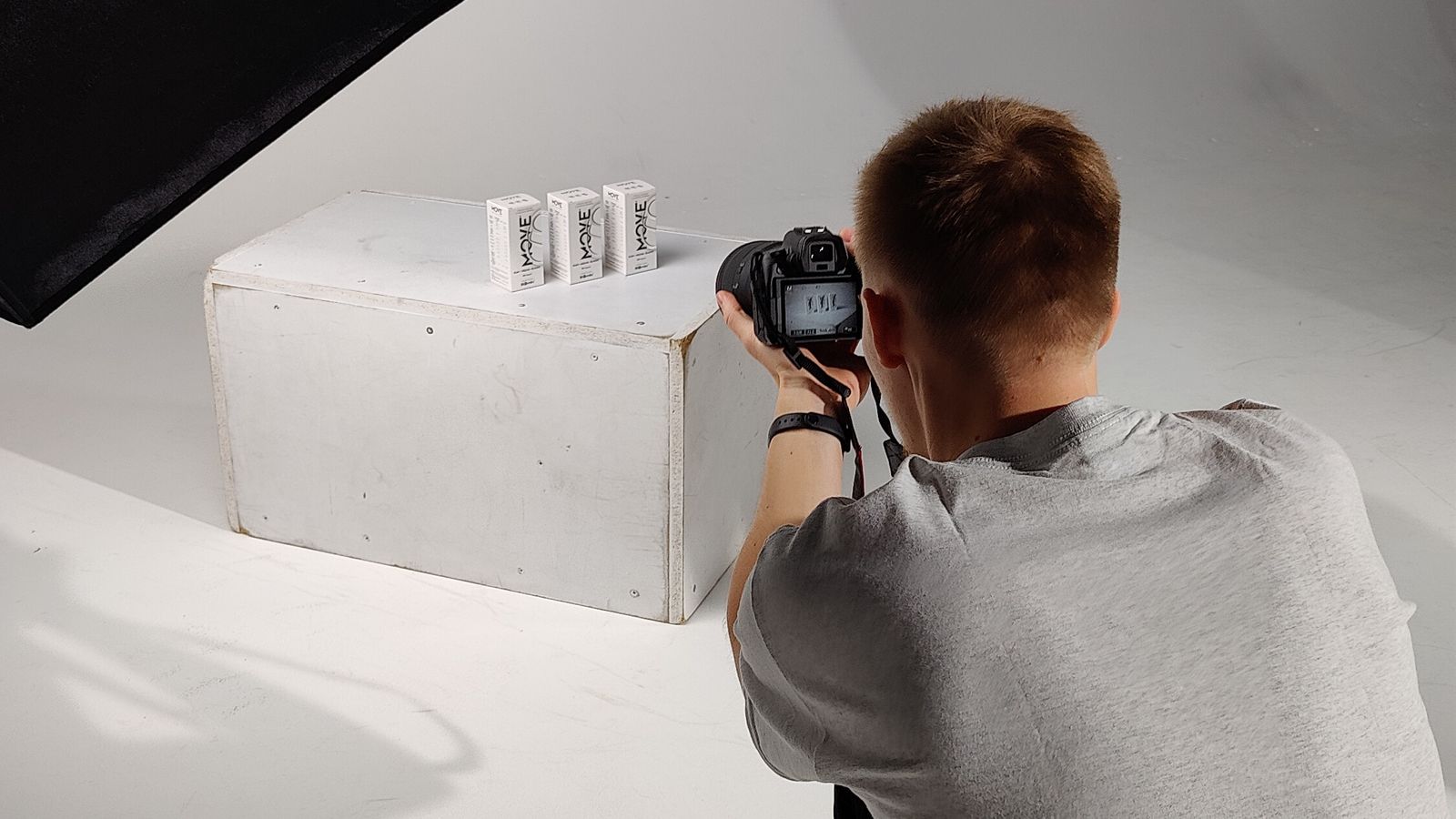
Day one is stills. A table, two lights, a phone with the lens cleaned. Every SKU from four angles. This is the step sellers skip and the step everything else depends on.
Day two is a three-frame board per SKU — first frame, middle, last. Reject at the board. Rejecting a board costs minutes; rejecting a finished render costs a day and teaches nothing.
Days three and four are generation and post: compositing labels, grading to a single reference, burning captions, then QC at twenty-five percent scale on a phone. If it does not read at that size, it does not work on the shelf, however good it looks on a monitor.
There is an honest trade-off on volume. For five to ten SKUs, generating each one individually is quick and gives each card its own logic. For two hundred SKUs of the same shape, a template pipeline with variable substitution is far cheaper and faster, but every card ends up looking related — acceptable for a catalogue, poor for differentiation in a crowded category. Decide which one you are building before you brief anyone.
Not everything survives this process. Furniture and appliances sold on precise dimensions still need real scale cues; a generated room can flatter a sofa that will not fit through the door. Regulated categories — supplements, medical devices, children's products — carry liability in every caption, so the video has to stay descriptive. Fast-changing packaging means every label revision is a regeneration, which is why the master project file matters more than the exported MP4. And marketplace video never replaces the main photograph: it is a second look that answers a doubt the first look created.
Before you upload
First frame is the product, not a logo. Vertical, 1080x1350 or larger. Six to fifteen seconds, loops cleanly with no fade to black. Captions legible at thumbnail size, no claim that needs a disclaimer. Label and packaging identical to the real item, verified frame by frame against the reference stills. No prices, links, phone numbers or competitor marks. Checked on a phone, on mobile data, with the sound off.
KAMOD is an AI video studio in Tashkent, working with sellers and brands worldwide. If you have a catalogue and an empty video slot, send us three SKUs and the photographs you already have — we will return a board for each, so you can judge the approach before commissioning a batch.